Apr 16, 2022 |


Do you know about the history of the office and how office designs have changed over time? While this may seem like an urbane topic, it’s actually interesting to see how trends have come and gone.
Office design has a large impact on employees. For instance, if you work in an office, then you may be spending up to one third of your life at work. That’s a phenomenal amount of time. Think about that for a minute. The office is our home away from home, and office design can have a huge impact on how we are feeling, our productivity and even our wellbeing.
In this article, we’re going to take a look at how offices have changed over time, and what has led to many office design innovations.
The first offices were created by Rome back in ancient times. In fact, offices were a central part of cities and towns. A Roman city or town was traditionally centred on a forum, or square. Around the square, various businesses placed—everything from shops to offices, including government offices. In Latin, the official language of Rome, we derive our word “office” from “officium” which means something like “bureau.”
After the fall of the Roman Empire, offices went out of use. In their place, the home office became the place where business was conducted. In that time, many people had homes over their shops. They may have also employed clerks who lived there to help with everything from paperwork to cleaning.
It’s a little bit funny to consider, but those who worked from home back then faced some of the same problems and advantages we face today when working remotely. They had distractions from family and friends, but at least there was no commute.
In the 18th century, offices outside of the home made a return. In Britain, the first two dedicated office buildings were constructed: The Old Admiralty Office and The East India House.
The Old Admiralty Office, also know as the Ripley Building, was built in 1726. This was a u-shaped building and was purposely created to house an office. The building was constructed for the Royal Navy and was used for various purposes. It included state rooms, offices, and apartments for the Lords of the Admiralty. Today, the building is used by the Department for International Development.
The East India House was built in 1729 and was the second office in Britain. It, too, was a multipurpose building. This office was the headquarters for the East India Company, and housed thousands of employees to take care of the bureaucracy needed to handle trading in India and Asia.
The famous author Charles Lamb worked in the building and wrote about the office in his diary, “On Friday I was at the office from 10 in the morning to 11 at night – last night till 9.” In other words, not much has changed. People worked long hours back then, just like we today.
While employees were granted holidays and bonuses, these were sometimes removed when things got difficult. And just like today, employees were known to play jokes on one another, and pretend they were working, when they were actually reading. However, the offices could be quite unpleasant.
Lamb left us another quote in his diary, “You don’t know how wearisome it is to breathe the air of four pent walls without relief day after day.”
Can’t you just feel the exhaustion in his words? There must have been plenty of employees dealing with depression and other issues as a result of working in a crowded, uninspiring place.
In the 20th century, Frank Lloyd Wright built an office with the first open plan workspace. This is the office layout most of us have had to deal with since then.
Wright built the Larkin Administration Building in 1906, based on the concept that the office should be very much like an open plan factory and not have many walls.
Many offices in that time were based on Taylorism, which was a principle productivity. Everything had to change, which included the installation of electric lighting, the telegraph, telephone, typewriters and even calculators.
Back then land prices were rising, which meant that building space was also becoming more expensive. This led to offices going from a broad horizontal layout, to buildings that were vertical. This is the time when skyscrapers become the norm for office buildings. With the use of steel frames, construction led to office buildings that were 10 storeys, and skyscrapers housing vast numbers of workers in a building that had a smaller footprint and was much taller than in times past.
If you think offices are unpleasant now, consider the offices back in that time. Workers’ desks were set one right next to the other, with no space in between. Managers’ offices were then placed on the outer edges of the floors. Lighting was fluorescent, air conditioning was introduced, and fresh air was no where to be found. Workers were completely cut off from nature and focused on the crowded offices. This type of office design was depressing and dehumanising. The emphasis was definitely not on employee wellbeing, but rather focused on meeting deadlines and staying productive.
Then the more relaxed 1960s culture began to overtake office culture and office design. There were two designs that were popular: the Burolandschaft and the Action Office. The Burolandschaft came to us from Germany, and it took a more regimented approach to office design. However, it did include some natural aspects such as plants, and made it easier for workers to interact.
The Action Office took some ideas from the Burolandschaft concept but added increased privacy for workers. This design trend used modular office furniture, and the introduction of flexible, semi-private workspaces for employees.
By the 80s, the cubicle farm had become the norm. This design trend used modular furniture and walls to create private spaces. This sounds like a good thing; however, the problem was that more and more cubicles were being crammed into the workspace. It was crowded and uncomfortable for those employees who were not managers. Managers were given private offices, while their employees tried to survive the cubicle farm.
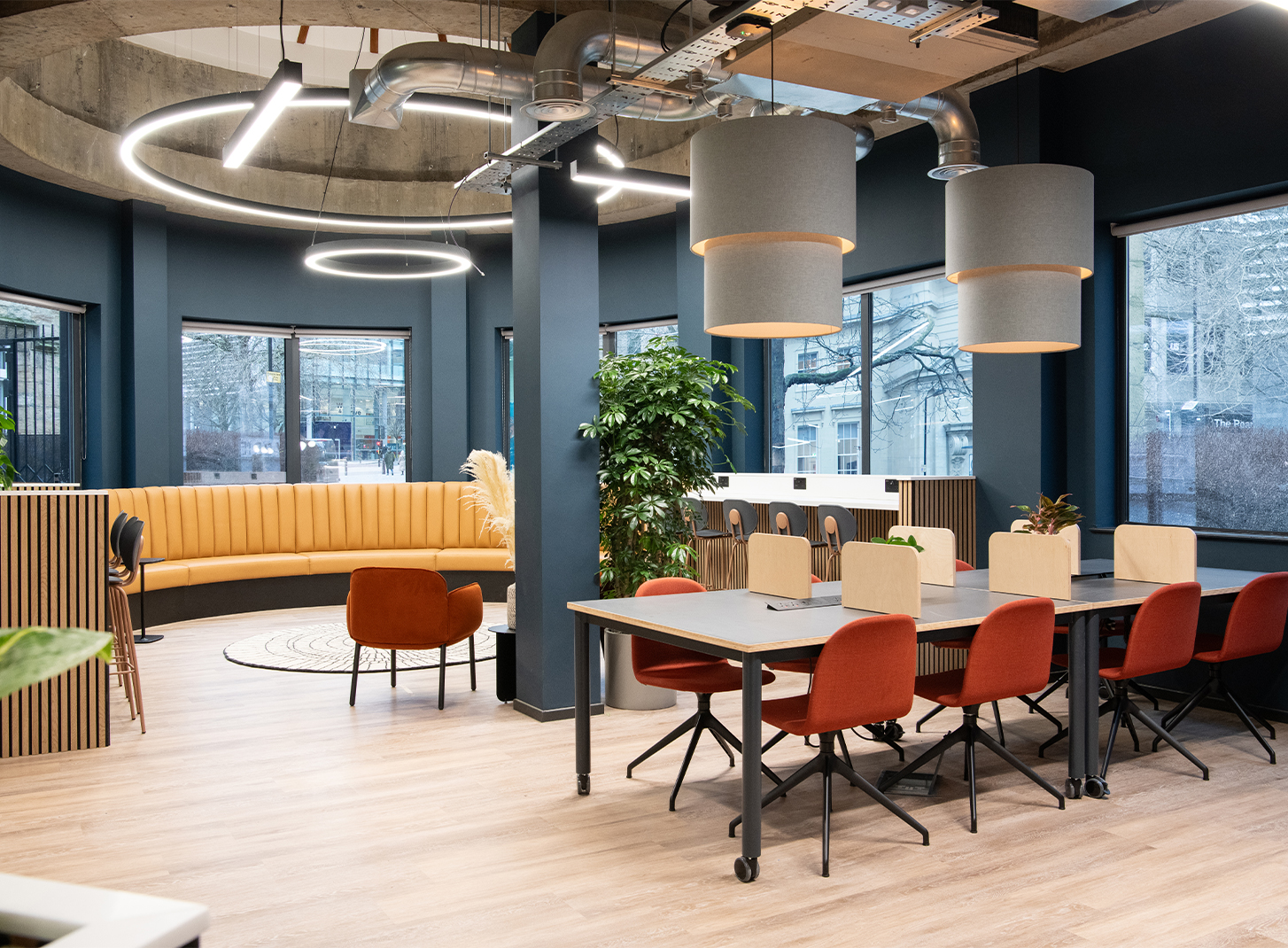
Current office design trends are centred on the employee, with emphasis placed on wellbeing, productivity and comfort provided in a more flexible workspace. While the open plan is still in use, modern businesses are also incorporating areas where employees can get away from the distractions of working in one space.
Some innovations include the use of phone pods, where it’s possible have a phone call without all the background noise of the surrounding office. Quiet areas, where employees can relax, are also becoming increasingly popular. Flexible workspaces are another great trend, which makes it easy for employees to use workspaces for working as individuals, or to collaborate as needed.
Other office design trends that are being used include the incorporation of natural design elements including plants and natural light. There’s also a deep concern for the environment, which has led to innovative office trends made to be more sustainable.
As we head into the future, even more emphasis will be put on the wellbeing of employees and the incorporation of technology. These are leading to the use of coworking spaces, hot desking and more.
Let’s find a workspace that loves you back.
Choose from 14 unique workspaces across eight locations in Northern England and Scotland.