May 26, 2026 |


Millions of people and businesses around the world are using co-working spaces. These days, workers go to work in an office facility not owned by the company and may sit at a different desk each day. Gone are the days of inflexible office designs and permanent workspaces for workers.
The evolution of co-working spaces has been longer than many people realise. In fact, this is a concept that’s been developing over the last 100 years.
Back in 1906, Wright designed the first open plan office in Buffalo, New York. The building was the Larkin Administration office for the Larkin Soap Company, which Wright designed without walls. This was a first in office design. The building including innovative touches such as built-in office furniture, air conditioning and more.
After falling on hard times, the Lark company had to sell the building. Then in 1950 the building was purchased by Western Trading Corporation and demolished to make room for a truck stop.
Wright went on to design another open plan office in 1939 for the Johnson Wax headquarters in Racine, Wisconsin. He created a large room which was used only by the company’s secretaries. The open plan was not used by everyone in the company, however, as the company executives continued to use private offices.
The open office plan was still not popular; however, in the 1980s a new concept took over. It was called “hot desking,” and was based on the “bed-sharing” found on submarines. With hot desking, one person was not found at the same desk every day. Instead, they shared the desk with others who worked at different times and/or on different days, thus making cost-effective use of existing office space.
Also popular in the 1980s were portable offices, with modular desks and cubicles. Portable offices and modular furnishings were another way to make better use of limited office space. Workers shared space but were sometimes separated by partitions.
Portable offices gave rise to the cubicle culture, as it came to be known. Once popular, these eventually led to overcrowding and “cube farms.” Workers were compartmentalized, making collaboration almost impossible while sitting in a soulless maze of cubicles.

In 1989, a British entrepreneur, Mark Dixon, founded a company called Regus after moving to Brussels. The company offered flat rental services for businesses; however, Dixon soon realized there was another arm to the market when he found that traveling business people didn’t have access to workspaces, other than coffee shops and similar places.
As a result, in 1989 Dixon began renting out serviced office spaces. The spaces were fully maintained, provided staff and more. The spaces could be rented on a flexible basis, making the serviced office space a great alternative for business people on the go.
As the open plan office continued to evolve, the rise of hackerspaces in the 1990s helped to continue the evolution that eventually led to co-working spaces. Hackerspaces first appeared in the 1990s in Berlin, which was a popular place for those in the tech field.
One tech community known as C-Base set up an informal workspace for those who wanted to improve their computer knowledge and skills. This was one of the first collaborative working spaces in 1995. The idea didn’t really become wildly popular until 1999, when the idea was taken to other countries.

In 1999, the first person to coin the term “co-working” was Bernie De Koven, a computer game designer in New York City, New York. To him, the concept of co-working was like-minded workers coming together to help one another in a collaborative, non-competitive environment. Koven didn’t create a business around this concept, but he is credited as being the first to use the term co-working.
Also in 1999, the first flexible workspace was opened in New York City; it was called 42West24. This space was created for software programmers; while they did sit next to one another, there was no collaboration involved and no sense of community developed.
42West24 survived the dot-com bubble, and became very popular with tech workers who were left with no work and no workspaces. The business is still going strong under the name “New York Office Share,” but still does not have that collaborative, co-working space atmosphere we’ve all come to know and expect.
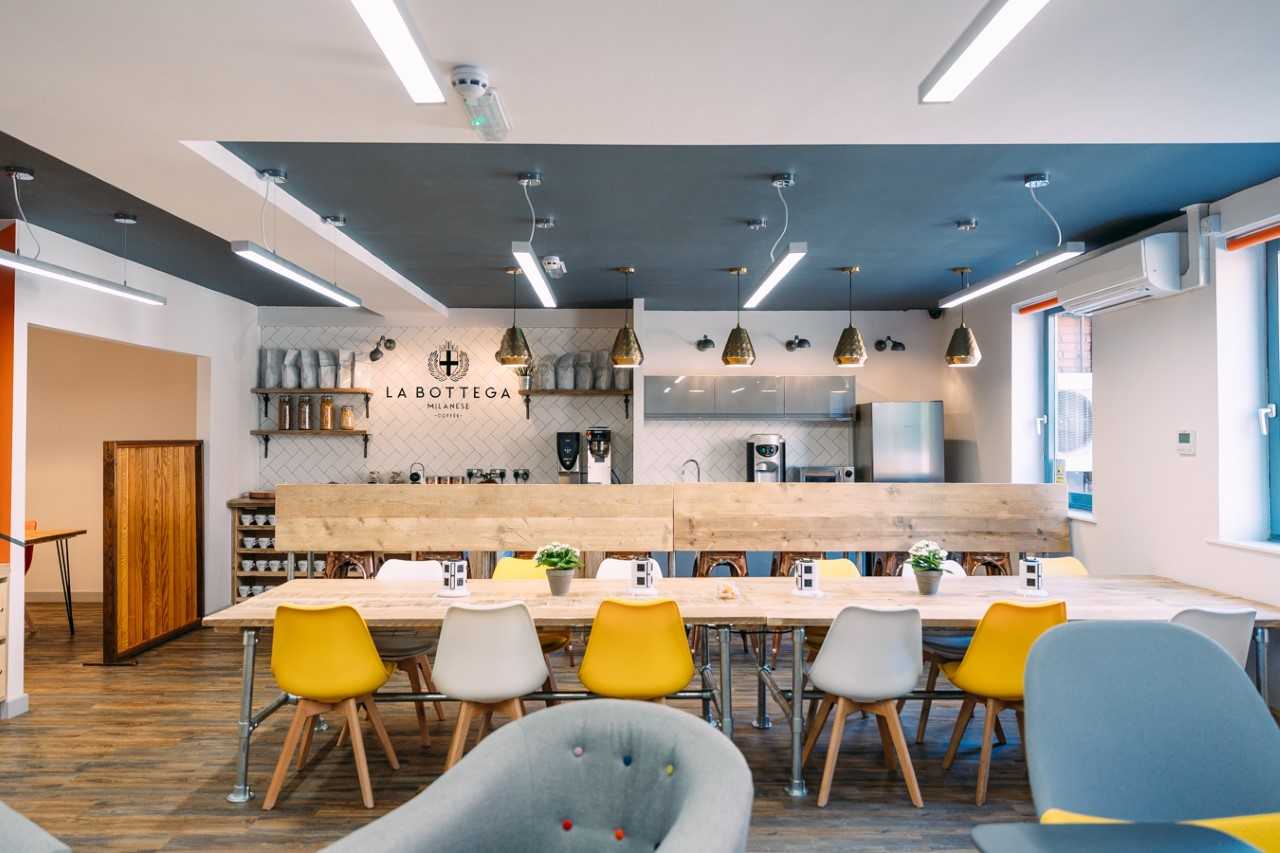
By 2005, the concept of co-working spaces finally reached maturity. A guy named Brad Neurberg took the previous versions of an open office plan, combined with flexible office space rentals and collaboration, and opened the first true co-working space. His concept worked in such a way that workers could find a place to work independently, on their own schedule, yet in a collaborative working environment.
By 2006, a business called the Hat Factory opened in San Francisco, and was the first full-time co-working space. Here, independent workers could come together and collaborate, relax and more. The business wasn’t able to survive, but it was the first dedicated co-working space as we know it today.
In the same year, the San Francisco Consulting firm began to let people come and use their WiFi and office space for free. However, they had to start charging for desk space once people began to enjoy the benefits the firm offered. Then Citizen Agency was formed, offering dedicated desk space and more for workers who needed a place to work.
From then on, the co-working concept has become ever more popular for businesses and individuals needing a cost-effective, collaborative place to work.
Flexible office spaces are becoming more popular in 2023, with many companies turning to the hybrid work style. Under the hybrid work model, employees spend some time working at the office and then working remotely the rest of the time.
The changes brought about by the hybrid work style have had a significant impact on corporate real estate. According to the Economist[SV1] , about 12% of all offices will be unoccupied in 2023. These high office vacancy rates are caused by companies starting to reevaluate whether they require a large office space any longer. Many businesses are considering whether smaller offices would be a better choice.
One of the most popular office choices has become the coworking space. Coworking working spaces are cost-effective and provide a supportive environment for the hybrid work model. But what makes coworking spaces continue to be so popular in this new era of downsizing office space?
Coworking spaces continue to evolve with the changing work environment. One of those changes is Coworking-as-a-Service. CaaS goes way beyond providing a great space to work. This new model means offering other benefits, too.
Benefits offered by coworking spaces can include the following:
Coworking spaces are finding it’s no longer enough to provide freelancers and startups with a place to work. In 2023, many companies are choosing to use coworking spaces as a way to provide great spaces for their employees to work. Not only that, but these spaces also allow organisations to downsize and save money at the same time.
Coworking spaces are offering way more than just a desk. They’re now offering a wide range of unique services. They’re looking for better ways to serve the community and become a space where you can get everything done.
Here are some services coworking spaces are adding:
A major development in coworking spaces this year has been the development of niche coworking spaces. These spaces are usually a part of a larger coworking network but are aimed at a specific target market.
Here’s a quick list of popular niche coworking spaces:
Another development in coworking spaces is those that promote natural connections. These coworking spaces focus on nature and sustainability. What’s more, they usually create a space where the interior and exterior are one. The result is an eco-friendly, sustainable workspace.
These spaces also provide eco-friendly products, such as reusable office supplies, natural lighting, green plant walls, and more. They also focus on optimising airflow in workspace, which cuts down on the spread of germs and keeps the air fresh for workers.
Coworking spaces are also broadening their services for corporate employees. Many businesses are looking for decentralised locations for employees who work remotely and part-time in the office.
Suburban coworking spaces are placed in the office where company employees live. The idea is to create a work hub in several locations, making it easier for employees to get to the office.
These are only a few of the ways coworking spaces have evolved in 2023. As things are going, there’s no question that coworking spaces will continue to be an essential workspace for all types of clients, including large organisations looking to downsize from large office spaces.
Let’s find a workspace that loves you back.
Choose from 14 unique workspaces across eight locations in Northern England and Scotland.