May 26, 2026 |


Co-working spaces work differently than traditional offices. Traditional offices really only serve one purpose. They’re spaces to get work done and then go home. Co-working spaces, on the other hand, offer so much more: they’re places to meet and share ideas with like-minded people; they’re often beautifully designed; they tend to have friendly, vibrant atmospheres, and they’re designed to help businesses and freelancers grow and succeed.
A lack of all these factors in traditional offices are what led Wizu Workspace to come to be in 2015. Wizu was set up as a space to fulfil all that was lacking in many offices at the time. Wizu’s founders wanted to build a reputation as a space with impressive design and high-quality amenities and facilities. Overall, they wanted to be known for being nice to people.
This carries on a tradition upheld by co-working spaces around the world. Many of those who opened, innovated or even invented co-working spaces had the same intuitions: that workspaces needn’t be drab, unfriendly and unproductive spaces. Wizu represents some of the most important aspects built throughout co-working’s history, by providing freelancers and small businesses with a vibrant and collaborative space which is beautifully designed and gives them access to the best amenities so that their enterprise can grow.
Recently, FreeOfficeFinder delved into the history of the co-working office. Thinking about Wizu Workspace’s place in that story, we wanted to look at some of the key moments from co-working’s history.

In the autumn of 1995, seventeen computer engineers create one of the first ever ‘hackerspaces’, C-Base, in Berlin, Germany. Hackerspaces are obvious precursors to co-working spaces. The hackerspace is intended as a not-for-profit space which brings together computer enthusiasts, offering them facilities, as well as an opportunity to collaborate, share knowledge and equipment. Given the dawn of the internet, computer engineers no longer need a fixed place to work, so the space is set up to give them a place to work alongside others in their field, where they can collaborate and share new ideas.
Bernard DeKoven coins the phrase ‘coworking’. However, the term refers to something different than today’s concept of co-working. DeKoven, a game designer, uses ‘coworking’ to refer to the way we work, not the space that we work in. He hopes to evolve ways of working that involve collaboration, a breakdown of hierarchy and seeing co-workers as equals.

Two Austrian entrepreneurs set up an ‘entrepreneurial center’, Schraubenfabrik, in an old factory in Vienna. The space is aimed at entrepreneurs, giving them a place to avoid having to work from home, where they can collaborate and work with like-minded people. The space included architects, PR consultants, startups and freelancers. This space is clearly the mother of co-working and although not called a ‘co-working space’, it’s undoubtedly a clear precursor to what we know today.

On August 9th, Brad Neuberg sets up the first ever official co-working space, San Francisco Co-working Space, at a feminist collective called Spiral Muse in the Mission district of San Francisco. The space is intended to maintain the freedom of working independently whilst providing the structure and community of working with others. Neuberg has to pay $300 (£230) a month to use the space for two days a week. For the first month, no one turns up. After more outreach from Neuberg, an athlete and startup developer named Ray Baxter arrives, becoming the spaces first member and in turn the world’s first official coworker.

From 2006, the number of co-working spaces and co-working members approximately doubles each year for the next seven years. This exponential growth will soon become known as the co-working revolution.
Co-working visas are introduced, meaning that members of specific co-working spaces are given free access to other co-working spaces also included in the agreement. This means that workers who travel can use co-working offices all around the world without having to spend extra money and also develops the global co-working community. The key ideas around co-working and collaborative working are developed and continue to spread around the globe.

The first online magazine about Co-working, Deskmag, goes online on July 10th. The magazine is based in Berlin and covers all aspects of co-working, writing articles on the development, function and design of co-working spaces.

In 2012, 93,000 tweets are sent with hashtag #coworking. This is more than twice as many as the previous year, mirroring the doubling of co-working spaces and members which continues year on year. With and without the hashtag, the word “coworking” is included in 217,000 tweets overall.

There are currently 12,100 co-working spaces worldwide, with around 835,000 co-working members. Larger co-working spaces which can hold more members are starting to grow, meaning the exponential growth of co-working has started to slow, yet growth is still quite exceptional.
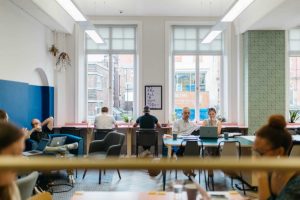
London is currently the capital of co-working, with more co-working spaces than New York, San Francisco and Berlin. Co-working occupies 10.7 million square feet of office space in Central London alone.

Co-working is predicted to continue growing. Forecasts show that by 2020 there will likely be 26,000 co-working spaces with over 3.8 million members worldwide. By 2022, that number is likely to be around 5 million co-working members. Considering how recently the phenomenon of co-working came about, these figures are quite astonishing. People around the world are still continuing to learn of the benefits of co-working, joining co-working spaces and, given the incredible growth of the phenomenon, they’re clearly not leaving their co-working space anytime soon.
Interesting blog? Fancy trying this whole ‘co-working’ thing out for yourself? Click here to book a viewing and your two free co-working taster sessions that stretch across both of our luxury, Leeds city centre addresses.
Let’s find a workspace that loves you back.
Choose from 14 unique workspaces across eight locations in Northern England and Scotland.